
Christmas doesn’t usually create operational problems. It exposes the ones a business has been managing around all year.
A missed follow-up that was merely annoying in August becomes a lost sale in December. Stock records that were “close enough” suddenly matter when the last available units have already been promised to someone else. A process that depends on one experienced staff member becomes much harder when that person is on leave.
And because everyone is busier, the usual workarounds stop working quite so well.
Preparing for Christmas therefore isn’t only about ordering extra stock, confirming trading hours and putting leave into the calendar. It is also a good opportunity to look at the parts of the business that will come under pressure when enquiries, orders and workloads increase.
You don’t necessarily need to overhaul everything before Christmas. In fact, you probably shouldn’t.
But there are a few areas worth getting right before the rush begins.
Turn enquiries into sales
More enquiries should mean more sales. It doesn’t always work that way.
During busy periods, quote requests arrive while staff are dealing with existing customers, phones are ringing and somebody is trying to solve three other problems at once. An enquiry gets answered, a quote goes out, everyone intends to follow it up — and then nothing happens.
A week later, somebody asks what happened to that customer. Nobody quite knows.
Before Christmas, make sure every genuine sales opportunity has four basic things attached to it:
- someone responsible for it
- a clear status
- a next action
- a date for that action to happen
This is where a good CRM system becomes useful.
Rather than relying on individual inboxes, handwritten notes or somebody remembering to make a call, a CRM gives the business a shared view of open enquiries and quotations. You can see what has been sent, what needs following up and which opportunities are starting to go cold.
That matters commercially. If the business has already done the hard work of generating the enquiry, losing the sale because nobody followed up is an expensive way to be busy.
Before December, take a look at your current enquiries and open quotes. If you cannot quickly tell which ones need attention today, that is worth fixing.
Know what you can actually sell
The best possible Christmas problem is strong customer demand. It becomes a less enjoyable problem when you accept the order and then discover you cannot fulfil it.
For businesses carrying stock, now is the time to review the products, materials and components that become difficult to replace once suppliers get busy or begin their Christmas shutdowns.
But simply ordering more stock is not necessarily the answer. The more important question is whether the business has a reliable view of what is actually available.
There is a difference between:
20 units in the warehouse
and
20 units in the warehouse, 15 already committed to existing customer orders, leaving five available to sell.
That distinction becomes very important when sales activity picks up.
A good inventory process should help the team understand what is physically on hand, what has already been allocated, what is arriving and when replenishment may be required.
Depending on the business, that might involve better stock controls, reorder points or an inventory management system that connects purchasing and customer orders.
The commercial benefit is fairly obvious: fewer stockouts, fewer urgent purchases and fewer situations where a willing customer is told, after placing an order, that the product is no longer available.
It can also protect margins. Last-minute freight, emergency supplier purchases and substitutions have a habit of making an otherwise good sale considerably less profitable.
Plan around your real capacity
Not every business carries inventory, but almost every business has capacity.
It might be production hours, delivery vehicles, technicians, installers, machinery, appointment slots or simply the number of jobs a team can realistically complete in a week.
Christmas puts all of those resources under pressure at the same time that staff begin taking leave.
Before accepting another round of December work, map out what the business can genuinely deliver.
Look at things such as:
- staff leave
- existing customer commitments
- production or job capacity
- delivery availability
- supplier shutdown periods
- specialist employees who may become a bottleneck
- customer deadlines and Christmas cut-off dates
A shared scheduling or planning system can make this much easier because the person accepting work can see what capacity actually exists.
Without that visibility, businesses can accidentally make decisions one order at a time.
One more job looks manageable. Then another. Then another.
Individually, each promise seems reasonable. Collectively, the business suddenly has two weeks of work that needs to fit into five days.
The aim is not to stop saying yes to customers. Quite the opposite.
Better visibility lets you confidently take more work when the capacity is genuinely there — and make better decisions when it isn’t.
Give customer information a clear home
Christmas is a particularly bad time to discover that important information is scattered across emails, spreadsheets, text messages and conversations.
A customer changes a delivery quantity by email. Someone updates the spreadsheet. Another employee is still working from the original order. Then the customer rings asking why the wrong quantity arrived.
The individual mistake may be small. The process behind it is the bigger issue.
Where possible, customer information should have a clear home.
That might mean using an order management system where the customer, products, pricing, delivery details and order status are kept together. It could also mean tightening an existing process so that changes are recorded consistently rather than living inside someone's inbox.
The same principle applies beyond product businesses.
For a service company, it may be the latest job instructions. For a trade business, it might be site details or variations. For a professional services firm, it could be an approval or customer request that affects the next stage of work.
The important thing is that the person who needs the information can find the current version without first working out who last spoke to the customer.
That becomes even more valuable once people start taking leave.
Make holiday cover work
Most growing businesses have at least one process where a particular employee simply knows how things work.
That is not necessarily poor management. It happens naturally.
Someone has looked after a group of customers for years. Another person knows the supplier arrangements. Somebody else understands the spreadsheet that apparently requires a minor archaeology degree to operate.
Usually, the business gets by. Christmas leave is when those dependencies become obvious.
A useful test before the holiday period is to have somebody else perform the process while the usual person is still available.
- Can they find the customer history?
- Do they know what happens next?
- Can they see which orders are outstanding?
- Do they have the right access?
- Do they know who can approve an exception?
If not, you still have time to fix the gap.
Good systems help because customer history, notes, activities and work status can be shared rather than sitting with one individual.
But this is not purely a software problem.
Responsibilities need to be clear. Basic procedures should be documented. Staff covering another role need to know what decisions they can make without escalating everything back to the person who is supposedly on leave.
The goal is straightforward: routine work should continue without somebody having to answer “just one quick question” from the beach.
Turn finished work into invoices
The Christmas rush is not particularly valuable if the work gets completed in December and invoiced sometime in February.
This is an easy area to overlook because operational teams are understandably focused on delivering for customers. Administration catches up later.
Invoices remain in draft. Completed jobs still need someone to confirm a price. Delivery information has not reached accounts. Supplier costs are waiting to be matched.
Meanwhile, the business has already paid wages, suppliers and freight.
Before the busy period, look at the path between completing the work and sending the invoice.
- How many manual steps are involved?
- Who has to tell finance the work is complete?
- Does somebody need to re-enter information that already exists elsewhere?
- How quickly can an invoice actually be produced after an order ships or a job is finished?
Where sales, operations and finance work from connected information, much of this process can happen naturally as the transaction progresses.
Where they operate separately, the handoff needs to be particularly clear.
Either way, the principle is the same: finished work should not sit around waiting to become revenue.
Fix one problem properly
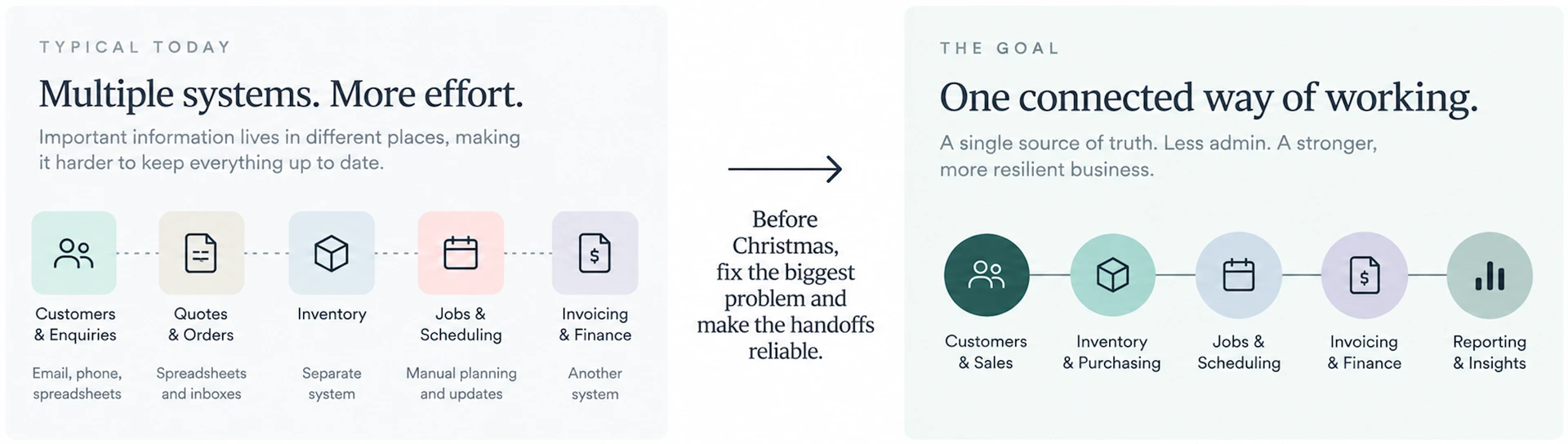
There is an ideal version of many businesses where customer enquiries, sales, inventory, purchasing, jobs and finance all work together on one connected platform.
That can remove a lot of duplicated administration and give the business a much clearer view of what is happening.
But September or October is not automatically the right time to replace every system the business relies on. A rushed transformation can create more risk than it removes.
A more sensible pre-Christmas approach is often to find the one problem that will hurt most when activity increases and fix that properly.
- If missed enquiries are costing sales, focus on CRM and follow-up.
- If stock availability causes constant trouble, improve inventory management.
- If nobody can see what work has been promised, start with planning and scheduling.
- If customer requests are disappearing between people, fix how those requests are captured and managed.
One meaningful improvement can make a noticeable difference during the busiest part of the year.
Make the handoffs deliberate
There is, however, an important catch.
Installing a new CRM does not magically fix inventory. Improving job scheduling does not automatically update finance.
And putting one process into a new system can actually create more work if nobody thinks about what happens before and after it.
So when you improve one area, ask two questions:
What information does this process depend on?
and
Which other processes depend on the information it creates?
Imagine you introduce a new CRM before Christmas while inventory remains in the existing system. That can still work perfectly well.
But the business needs to decide how the two processes interact.
- Who checks whether stock is available before confirming an order?
- Where is the final quantity recorded?
- When does somebody update the inventory system?
- If the two systems show different information, which one is treated as correct?
These decisions are not particularly glamorous, but they are what keep a business running.
The same applies to any combination of new and existing systems.
If everything cannot be connected before Christmas, make the handoffs deliberate.
Decide which system is the source of truth for each important piece of information. Make ownership clear. Keep the surrounding processes current. And test the process before the volume arrives.
Otherwise, a shiny new system can simply become another place for staff to enter the same information.
Start with what matters most
The objective before Christmas is not perfection.
It is to make sure increased activity does not create a disproportionate increase in administration, mistakes and chasing.
If sales increase by 20%, you should not need 50% more manual work just to keep up.
And if that is what normally happens every December, there is probably a process worth looking at now.
Start with the problem that affects revenue, customers or staff time most. Fix it properly. Make sure it still works with everything around it.
Then, once Christmas is over, you can decide whether that improvement should remain standalone or become the first step toward a more connected way of running the business.
